

This year, Armistice day marks 100 years since the end of the Great War. Today, as we’ve done every year since moving to France, Ange and I went with the rest of our village to the memorial in Moux to remember those who died in both wars. The children of the village read out all the names on the memorial, adding ‘mort pour la France’, ‘mort en champs d’honneur, or ‘disparu’. I took one of my dad’s books; this year; “1918, Year of Victory”, and introduced him to some of our French friends. My regret is that dad didn’t live to see the centenary.
During our travels in France and beyond, we’ve visited many of the cemeteries and memorials, such as Thiepval on the Somme, the Canadian Memorial at Vimy, the Indian cemetery on the western front, memorials in the Caribbean, and Australia. The Commonwealth War Graves Commission cares for all grave sites across the world. Even if there’s only one grave under their care, in an otherwise unlikely cemetery, there’s usually a plaque outside to inform you that it is there; in a corner of a foreign field.
About a week ago, we wondered if there were any Commonwealth war dead in the Languedoc. As it wasn’t a theatre of the Great War, we didn’t expect any, but with the movement of armies during the conflict, there was always a possibility. Surprisingly, a search of the CWGC website brought up two in our own department; the Aude. The website gave no explanation why they happened to be here, so we did some further research and paid them a visit.
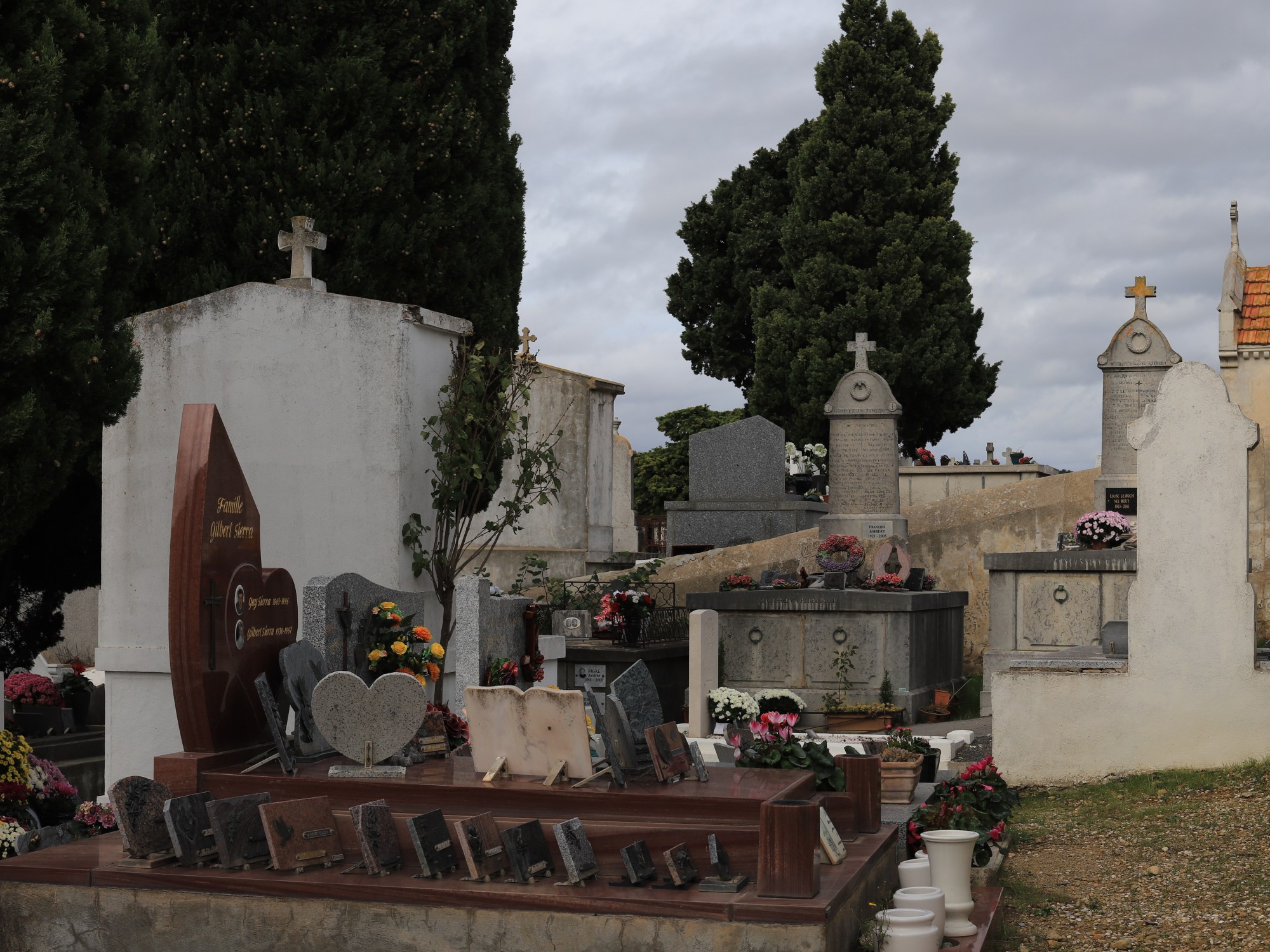
Captain Eric Cograve Simpson, died on 5th May 1917 and is buried in Gruissan; a small town surrounded by salt pans, a sandy beach and views of the Pyrenees. Further research revealed he was on a troop ship, the SS Transylvania; sunk by a U Boat off the coast of Italy. We found his grave, as described by the CWGC records, in the north-east corner of the town cemetery, surrounded by family mausoleums. As we’ve come to expect, the grave was well tended, with the usual familiar headstone. Ange left a posy of flowers from our garden, including rosemary; long associated with remembrance. We were touched to find there was already a fresh pot of chrysanthemums left by the municipality on November 1st, All Saints Day, together with a French tricolor; “en souvenir” (in remembrance).
In the city cemetery of Narbonne, close to the main gate, is the grave of Gunner Frederick Bishop of the Royal Field Artillery. He died on 20th October 1914. How he came to be buried in Narbonne proved harder to uncover. Given the date of Bishop’s death, he must have been a professional soldier. His Unit is given as Meerut Divisional Artillery column. Meerut is a city in India. At the outbreak of the war, the first two months of fast-moving conflict decimated the British Army, so brigades of the British Indian Army hurried to the front, landing in Marseille, and arriving in Flanders on 19th October. I’m indebted to Paul Stanyer who informs me that, IWM states that Gunner Fred Bishop died as a result of a railway accident. Death certificate states that he died in Narbonne hospital at 9 am on 20 Oct 1914.
His grave is equally well looked after. The headstone looked new and chrysanthemums had been placed there on November 1st. Ange laid a posy on his grave and we stood in silence for a while.
Next year, 101 years on from the first Armistice day, we’ll visit both Frederick Bishop and Eric Simpson again, we’ll widen the search for other Commonwealth war graves in the south of France, and we’ll join the rest of our village in the walk to the Moux memorial to ensure none are ever forgotten.
 lemouxetaire
IWM states that Gunner Fred Bishop died as a result of a railway accident. Death certificate states that he died in Narbonne hospital at 9 am on 20 Oct 1914.
LikeLiked by 1 person