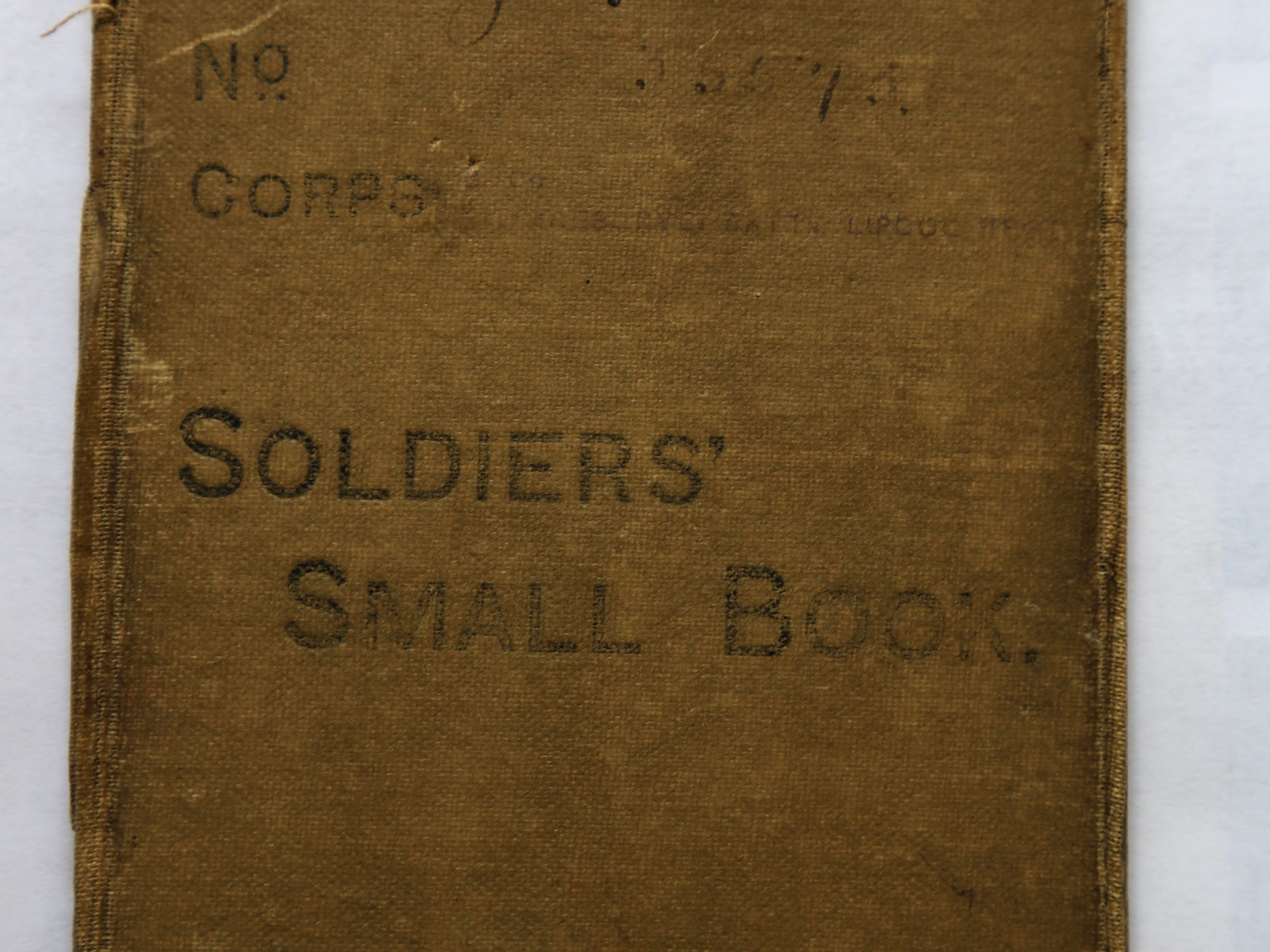


The Soldiers’ small book.
I’ve come into the temporary possession of a ‘Soldiers’ small book’ from the great war. It belongs to my pool playing buddy, Nev. When it was issued on 1st march 1916 it was in the name of James O Knowles, number 35573, 21st battalion, Kings Liverpool regiment. Nev lent it to me so I could do some research on it and learn about its original owner.
The book is khaki, cloth bound, about 6 inches by 4, the pages have matured to a comforting beige, the black print is still crisp. It’s a handbook for new soldiers, with information such as how to recognise higher ranks, instructions for cleaning socks and khakis, and points to be observed when on guard. Only a couple of pages are completed, presumably by James Knowles himself, although they’ve been completed at different times and with different pens. Inside the front cover is a travel pass issued to soldiers and an invitation to a church service on the coming Good Friday.
So what do we learn from the completed pages about Mr. Knowles. He was 22 at the time of signing up; born in 1894. His complexion is described as fresh, eyes; blue, hair; fair, and height, 5′ 43/4. Born in St Helens, church; CE, his next of kin is his mother; Esther Knowles, of 34 Bickerstaffe st, St Helens.
Armed with all that information I start to investigate.
My dad was an author of books on the great war, many under the auspices of the Imperial War Museum, so that source, and the Commonwealth War Graves commission, are where I begin my search. But it’s not as easy as I hoped. I can find plenty of James Knowles, and ‘J’ Knowles, but the service numbers are all wrong. I widen the search, using google and accessing war service records in ‘Findmypast.com’. Still, I find nothing conclusive. I don’t know if James survived or died, or if he changed regiment. Why I can’t find his number, remains a mystery.
I know that a lot of great war records were lost in a fire in the second world war, in London during the blitz, so that will make the search even harder. I search on his address. 34 Bickerstaff Street, St Helens, no longer seems to exist, but it must have done in the early 20th century; perhaps destroyed in the second world war?
I search, and find an impressive archive; ‘St Helen’s rolls of honour’. This comprehensive record commmemorating the St Helen’s heroes of the war has been lovingly collected, pulling together information from war graves and Census information. In it, I find his brother.
Percival Peer Knowles, born 1897, of 34 Bickerstaffe street, enlisted into the same regiment, on the same day as his brother. I know this because his service number is 35571, but at some stage, he joined the Borders regiment and changed his service numbers. In the record there is also census information from 1901 and 1911, mentioning James O Knowles. I learn that Percy was killed on 19th August 1918 and is commemerated on a plaque on Ploegsteert memorial; his body presumably never found. He must have died at Passchendaele.
There’s more; the rolls of honour state those lost from the same family; brothers. But although there are Knowles’ registered amongst them, Percival is the only one from his family to be registered. I can assume that James survived the war.
So I’m left wondering what happened to him?
Just to make sure, I check the records of deserters and conscientious objectors; he’s not among them. Perhaps he too changed regiments and service numbers?
I continue searching on the other details; notably the address. It’s then I find first one postcard from James to his home, and, days, later, a second, from James to his father. I buy them. They were both sent from Ripon, Yorkshire. They are both of the same scene; Spa Gardens and Hydro room; a sepia tone picture of a bandstand and the spa. The first is stamped 28 Nov 16; the same year he joined up. The second is dated a year later; 13 september 1917.
I continue the research and learn that there was an army hospital at Ripon. I can only assume that James was injured severely enough to keep him out of the war. Either that, or he had moved to the Royal Army Medical Corps. The latter seems unlikely as he would more probably have been at the front.
The two post cards arrive in my letter box. I read the two archives, written by James himself, 100 years ago. James is in good spirits in both. The first from August 1916:
‘Dear All,
I have to go to see Mm. McPherson, the Chaplain, tonight. He says he would like to talk to me, so I am afraid that a letter will have to wait. We are quite well & good. Did you hear about the Zepps? I will will tell you all about it later.
Best of love
James.
The second, from September 1917, indicates changes in the family circumstances, and James has done some travel; maybe home leave? Its adressed to his dad; Mr. Knowles (Chauffeur), at a North Wales address.
‘This is where the band plays on Sunday Afternoons. (When the rain lets it)
Ripon
Dear Dad,
Did you get to your destination safely? I arrived at beautiful Ripon quite early (9.20 in fact). Of course its still raining heavily as usual. Sid got the 8-19 all right.
Best – love,
James.’
(Note; Sid was James’ younger brother).
o0o
Despite continued searches I can’t find anything more on James. Injured soldiers wore a distinctive uniform; a blue suit, white shirt and red tie, and their own, regimental caps, in order to show that they had served and could be distinguished from anyone who had not. So I imagine James, carrying a significant injury that kept him out of the rest of the war, and also witnessing one of the many Zeppelin bombing raids.
The next release of census information is not till 2022 for the 1921 census, so I’ll return to the subject then and see if there’s anything on James, his father or surviving younger brothers. Before then, I’ll commemorate Percival Peers Knowles on the centenary of his death; 19th August 2018.
 lemouxetaire