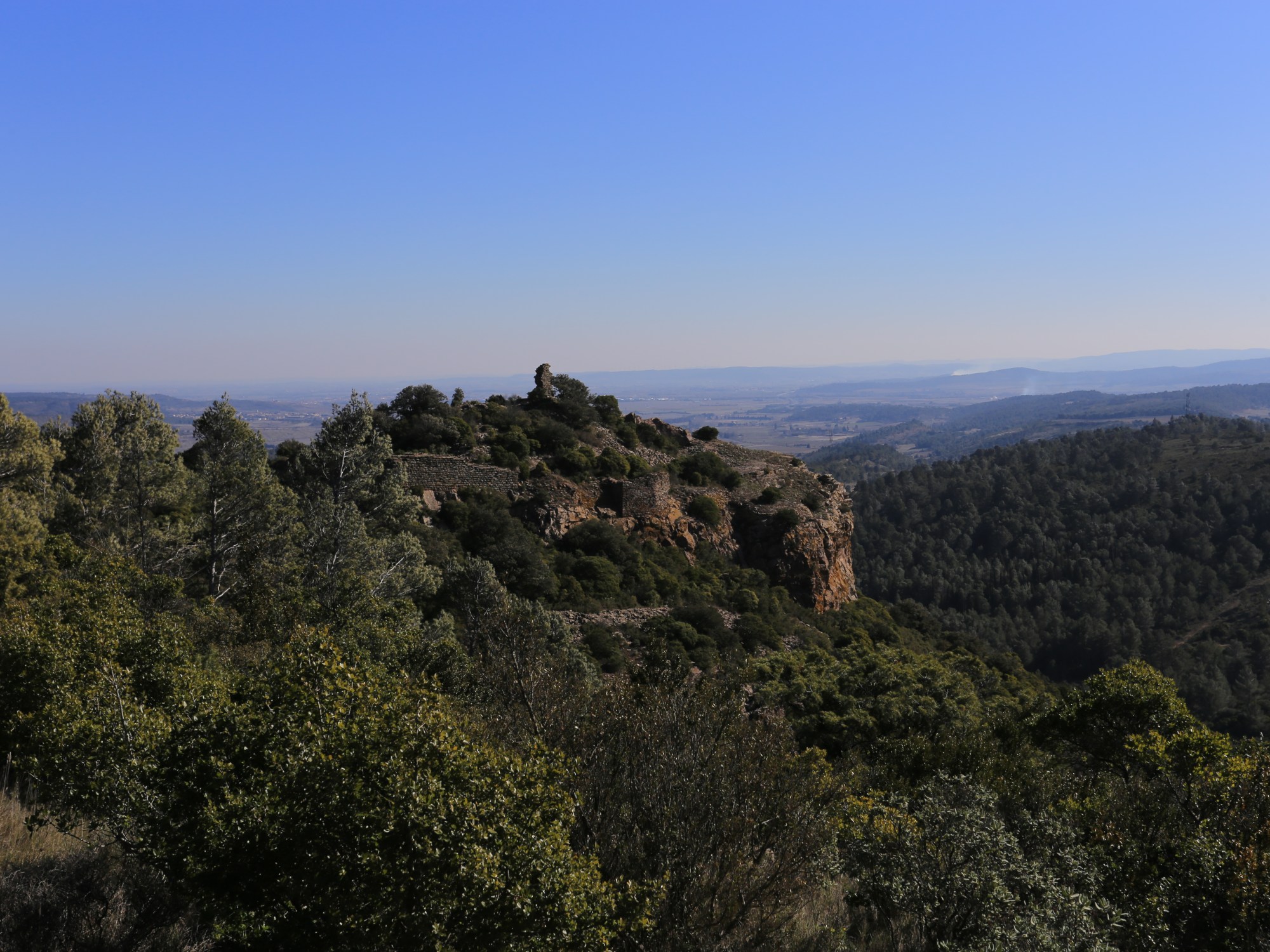
The village of Moux has history, a lot of which has been forgotten, or misplaced. Our major landmark is le Signal; the summit of Mont Alaric, 600 metres high, and the confluence of two Grande Randonees, the long distance paths of France. The first, GR36 is the longest path in France, from Normandy to the Mediterranean. The second, the GR77, winds its way down the mountain, past le Roc Gris, past the tomb of Henri Bataille and its macabre statue, into the village, passing right outside our door, then onto the Canal du Midi and, eventually, Minerve. Halfway between Le Signal and Moux, is a ruin, named on the maps ‘Le Prieure de St Piérre’. A recent archaeological investigation is proving that it’s much more, it’s a ‘Cathar chateau’, no less. It seems to me and others, that a misreading of the record has misplaced ‘Alaric, on the end of its mountain, fell (to the crusaders) in the teeth of a howling gale,’ to Alairac; a town south of Carcassonne. But Alairac has no mountain and the archaeological evidence points back to our mountain. Time for the Chateau d’Alaric to retake its place in history.
It’s against this background that we walk the dogs every day, whatever the weather. This year, February began with a return of high, very cold winds and rain. Apart from the odd day, most of the month we’ve suffered from a combination of these conditions, even as late as the 23rd, which started with a bitterly cold wind from the west. It’s been a hard winter, in comparison to both last year and the year before. It makes walking with the dogs a challenge. If we go out east of the village, before we’ve gone a kilometre, the winds are just too harsh and bitingly cold, so, as much as possible, we stay in the lea of Mont Alaric and the Roc Gris. We found a path below the Chateau; new to us, and, as yet, unmarked, that took us down to the dried-up riverbed at the base of the ravine, up the other side, winding through the trees for a kilometre, to eventually join up to the GR36 towards the summit of Mont Alaric.
Out amongst the vines, not much has changed since January. There’s a return of colour to the landscape, supplanting the wintry browns; green in the fields, and the white blossom of almond trees, but no signs of buds on the vines. There’s still a lot of pruning going on, for those hardy enough to brave those winds. Some fields still to be done look neglected. At the beginning of February, we saw a lot of small, controlled fires. At first, I thought they might be for protection of the vines against frost, but it seems it’s just cleaning up after weeding.
As well as pruning, there’s the job of repairing the wires that frame the vines. Most of the vines are regimented, trained on wires between stakes, to help keep them accessible at harvest, especially for machine harvesting. The wires need to be repaired, replaced, and the vines attached using plastic covered wires or cloth ties.
Our companions in the fields still include the hunters, their dogs, the vine workers, vine owners, and their dogs. There’s also plenty of wildlife out there, despite the weather. Both Manon and Polly love to hunt, leading with their noses, rooting out birds and mice, but only rarely catching anything.
But there’s one species of wildlife we could do without; one that hatches out from its nests this time of year; the ‘pine processionary moth caterpillar’. These little bastards have ‘hairs’, toxic, and potentially fatal, to dogs and cats, and they’re none too good for humans either. There are many pine trees affected with their silky nests, so we must keep our eyes open for them and avoid during hatching, when they ‘process’, mouth parts to tail, across our paths to ground where they pupate. The stupid creatures even kill the trees that harbour their nests. Furthermore, what do moths do? All they do is bimble about your lamps telling you that your bulbs are still working, and they’re hot, as they burn their wings… stupid insects. All in all, a pointless piece of evolution.
Still, if that’s the only major gripe about life among the vines, Ange and I, our dogs and cats, are still happy.
This month I’ll showcase Prieuré Marie D’Albas. A Moux vigneron, and very good too. They make great reds, a great Corbiéres blanc and a fabulous rosé


 lemouxetaire